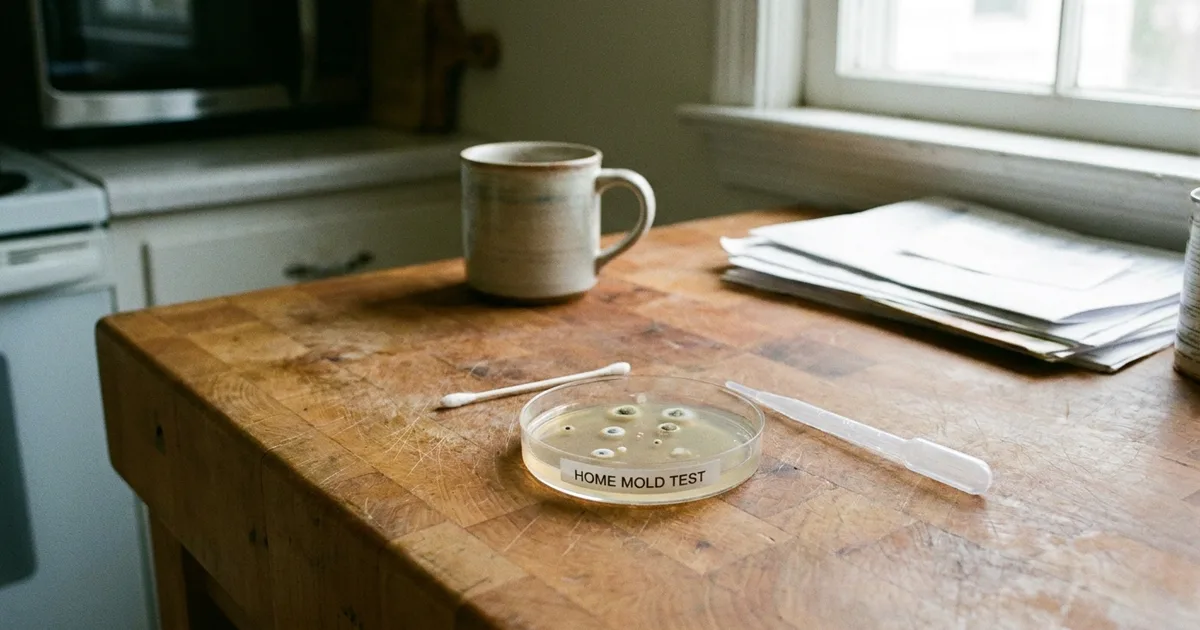
Before you buy a mold test kit from Home Depot, it is worth knowing that Florida ranked #1 on the national Mold Index with a score of 38.76 out of 40. And the most popular type of test kit is designed to grow mold colonies from whatever spores happen to fall into an open dish. In Florida, something will always fall in.
That is the trap. You suspect mold, you want to be responsible about it, and a $10 black mold test kit on the shelf feels like a sensible first step. But the honest answer to “do black mold test kits work” depends entirely on which kit you grab, and where you live. In the most mold-prone state in the country, the cheapest and most common kit type is closer to noise than information.
We sell professional mold inspection in Orlando, so you would expect us to tell you to skip the kit and call us. We are not going to do that. There are situations where a kit is genuinely fine and you should not bother calling anyone, and we will tell you exactly which ones. We will also tell you which kit type is a waste of money in this state, and the handful of situations where no kit on earth will solve your problem.
Black Mold Test Kits: Two Very Different Products Sold Under One Name
“Mold test kit” is not a single product. There are three distinct types sold under that name, and they have radically different accuracy profiles. Lumping them together is the first mistake most homeowners make.
Most common by far is the settle-plate petri dish kit (Mold Armor FG500, PRO-LAB MO109). You open a dish, leave it out for 24 to 48 hours, spores fall in by gravity, and colonies grow over the following days. This home mold testing kit tells you whether any mold spore landed in that one dish. It cannot identify the species, cannot tell you whether the mold is toxic, and cannot find anything growing behind a wall or inside an HVAC duct.
A clear step up is the lab-cassette air sampling kit (MyMoldDetective, PRO-LAB advanced). A battery-powered pump draws a calibrated 75 litres of air over 5 minutes through a collection cassette. You mail the cassette to an accredited lab, which returns a spore count per cubic metre and identifies the species. This is the same sampling method a professional inspector uses, which puts its raw numbers in a different league from the petri dish.
The third type, the rapid lateral-flow instant strip (AdVnt Informant Plus), works differently again. It is a surface swab with 15-minute results that targets specific species such as Stachybotrys and Penicillium or Aspergillus. The use case is narrow: confirming whether visible growth on one specific surface is one of those species. It is not a screen for hidden mold.
Almost everything sold at the hardware store and featured in “top 10 best mold test kit” listicles is the petri dish type. They dominate the search results because they are cheap, photogenic, and easy to list. Retail prices across all types run $10 to $90, with most petri kits landing at $30 to $40 plus a $40 lab fee where one applies. Now that we know what the most popular type actually does, which is catch falling spores, here is why that is a near-useless test in Florida.
Do Black Mold Test Kits Work in Florida? Why Petri Dish Kits Fail Here
RTK Environmental’s published data puts the settle-plate petri dish failure rate at up to 80%. That figure combines false negatives, where the kit misses an active colony, and non-actionable positives, where it flags mold that tells you nothing useful. Consumer Reports tested all the major petri dish kits and found every one of them had major problems. Their verdict is plain: they recommend against using them.
Florida turns that bad national picture into a near-guaranteed failure. The state ranked first on the national Mold Index with a score of 38.76 out of 40. Outdoor relative humidity sits above 70% for most of the year, so mold here grows year-round rather than seasonally. The scale shows up in the insurance numbers: Florida homeowners filed roughly 264,000 mold-related insurance claims in 2022, more than 20% of all home insurance claims in the state.
Here is the practical consequence. Because Florida’s outdoor air naturally carries high spore concentrations every month of the year, a settle-plate dish left open in any Florida home is almost certain to grow colonies. You would be paying $10 to $50 to confirm that air contains spores, which is always true here. That is not a diagnosis. That is a description of the climate.
The deeper flaw is that a petri dish has no outdoor baseline. A real assessment of mold test kit accuracy in Florida depends on comparing your indoor spore count against the outdoor count, because some level of spores is normal and expected. A settle-plate kit cannot do that. It just confirms spores exist, which is never in question in Central Florida.
Then there is the hidden mold problem. In Central Florida, mold commonly grows inside walls, in attics, and in crawl spaces, driven by ground moisture and poor ventilation. A petri dish sitting on your kitchen counter cannot detect what is growing six inches behind the drywall. The diy mold test kit you bought to catch a hidden problem is structurally incapable of finding the most common kind of hidden problem we see. Lab-cassette kits are a different story, though, and they are worth understanding before you write off all DIY testing.
Lab-Cassette Kits: Better, But With One Critical Flaw
Credit where it is due: the lab-cassette kit is the one DIY product worth your money in Florida. As described above, it uses the same calibrated air sampling a professional uses, and the lab returns a real spore count and species ID, not a dish of guesswork. Used correctly, its raw numbers are genuinely comparable to what an inspector would pull. If you are going to buy any home mold testing kit here, buy this one and skip the petri dish entirely. Its limit is not the hardware. It is knowing what the numbers mean.
A professional does not take one air sample and call it a day. They take an outdoor baseline, multiple indoor room samples, and targeted samples near suspected zones, then compare the relative counts against each other. That comparison is where the expertise lives. A homeowner who samples one room with no outdoor baseline can get a perfectly accurate count and still have no idea what it means.
So a lab-cassette kit earns its place in a few specific situations. The first is when a small, isolated patch of visible mold has recurred after you cleaned it, and you want a before-and-after comparison in one contained room. The second is when you want a directional read, a rough sense of whether the problem is bad enough to justify paying for a full professional inspection. For confirming the species of a colony you can already see, reach for the instant strip instead, since it is cheaper and faster at that one job.
On cost, a lab-cassette kit runs $60 to $90 with the lab fee included, or a cheaper kit plus a separate lab fee of around $40. Before you decide whether that spend is worth it, there is a Florida-specific regulatory layer most homeowners have never heard of, and it changes the calculation.
Florida’s Mold Testing Rules: What Your Kit Result Can’t Do
Florida regulates mold testing in a way most states do not. The Florida Department of Business and Professional Regulation (DBPR) licenses mold assessors and mold remediators separately, under Chapter 468, Part XVI of state law. A licensed mold assessor must conduct any formal mold assessment used for insurance claims, real-estate transactions, or legal purposes.
That single fact reshapes the whole DIY question. A black mold home test result, no matter which kit produced it and no matter how accurate the lab analysis, has no legal standing in Florida for any of those contexts. You can run the best lab-cassette kit on the market, get a clean species ID and a precise spore count, and an insurer or a real-estate attorney will still set it aside. It was not produced by a licensed assessor.
There is also a consumer-protection rule most homeowners do not know about. Florida law prohibits the same firm from both assessing and remediating mold on the same property. The point is to stop a remediation company from writing its own inflated assessment and then billing you to fix the problem it just diagnosed. When you hire a professional, make sure they are an assessor only, or that your assessment and your remediation come from two separate firms. Any company that offers to both test and fix on the same job is operating against the rule.
The state health authority lands in the same place. The Florida Department of Health does not recommend DIY mold sampling or testing as a first step. Its guidance is that if mold is visible, you should remove it or hire a professional to remove it. Testing before remediation is optional for a homeowner who simply wants the mold gone, but it becomes mandatory the moment insurance, a property sale, or a legal dispute is involved.
So the situations where a licensed assessment is genuinely required are clear: buying or selling a home, filing a mold-related insurance claim, a landlord-tenant dispute involving mold, and post-remediation clearance testing. With that regulatory context in place, here is the practical decision framework.
The 5 Situations That Mean Skip the Kit and Call a Pro
If any one of these five things is true, a test kit will not solve your problem. This is not “consider calling a professional if you have concerns.” It is a hard line.
- Musty smell but no visible mold. Hidden mold is the likely culprit, behind drywall, under flooring, or in your HVAC ductwork. No DIY kit can locate it. Finding it without cutting into walls takes thermal imaging and moisture metering, which is professional equipment.
- Recent water damage or flooding. Post-flood mold can establish within 24 to 48 hours in Florida’s humidity and spread through wall cavities before you ever see it. A settle-plate kit left out for 48 hours after a storm cannot tell elevated post-storm growth apart from the ambient spores that are always in the air. Professional moisture metering and thermal imaging are the only tools that reveal the full extent.
- Health symptoms tied to time in the property. A persistent cough, headaches, skin irritation, or respiratory trouble that eases when you leave the building are clinical signals, not DIY-kit signals. That pattern warrants a professional assessment, not a $30 test.
- You are buying, selling, or renting. A DIY kit result is legally useless for any property transaction. Only a written report from a licensed FL DBPR assessor has standing in Florida for real-estate disclosure.
- You are filing an insurance claim. Every one of those 264,000 mold-related claims Florida saw in 2022 needed professional documentation behind it. An insurer will reject a DIY kit result outright. You need a licensed assessor’s report.
Notice what most of these have in common: the kit is not just less accurate, it is the wrong tool entirely. A hidden colony, a post-storm wall cavity, a legal document, an insurance file. None of those are problems a dish on the counter was ever built to address. When you do call a certified mold assessor, here is what you are actually getting.
What a Professional Mold Inspection Actually Covers
This is what separates a licensed inspection from a kit, in concrete terms. A professional mold inspection in Orlando brings tools and deliverables that no DIY kit can replicate.
A thermal imaging camera detects moisture behind walls and under floors without cutting into anything, which is the single most important capability for finding hidden mold in Florida construction. Moisture meters and hygrometers pinpoint the damp zones actually driving the growth, not just where mold happens to be visible today. A borescope lets the assessor look inside wall cavities, HVAC plenums, and other sealed areas.
The air sampling itself is the same as a good lab-cassette kit, but the results carry weight a kit cannot. They are reportable under AIHA and IAQA standards, which is the format an insurer or adjuster actually accepts on a claim file. The real difference is sampling strategy. The assessor pulls an outdoor baseline and several indoor samples and reads them against each other, so a number means something. That interpretation, not the pump, is what you are paying for.
The deliverable is a written licensed assessor report that carries legal standing for insurance, real-estate transactions, and litigation. And the assessor who writes that report cannot also perform the remediation, which is the conflict-of-interest safeguard working in your favour. You get an independent diagnosis before anyone quotes you for the fix.
You came here wondering whether the $30 kit was worth it. The honest answer is that it depends on your situation, and now you have the framework to place yourself. If you have a small, isolated, visible patch and no insurance or transaction involved, a lab-cassette kit can give you a directional read, and you may not need us at all. If you recognised yourself in any of the five triggers, the kit is the wrong tool and a licensed assessor is the only thing that will actually move you forward.
If you are in Orlando and you are genuinely not sure which camp you are in, that is exactly what a free phone consultation is for. We will tell you honestly, including when it is not worth calling us yet. Call (321) 257-9332 and get a straight answer while the choice is still yours.