Florida filed roughly 264,000 mold-related insurance claims in 2022, more than one in five of all home insurance claims in the state. Orlando’s humidity is the reason, not bad luck. Average relative humidity here stays above 75% year-round, and once indoor humidity climbs past 60%, mold can colonize a damp surface in as little as 24 to 48 hours.
That makes a mold inspection a routine part of owning property in Central Florida, not a panic response. The trouble is that most homeowners book one without knowing what they are paying for or who is legally allowed to do the work.
This guide fixes both gaps. It walks through exactly what happens on inspection day, what a thorough inspection costs in the Orlando market in 2026, and the one Florida law that protects you from a common, legal-sounding scam. By the end you will know whether you need an inspection and what to look for before you pick up the phone.
Signs You Need a Mold Inspection in Orlando
Florida is the second most mold-prone state in the country, scoring 38.76 out of 40 on the national Mold Index, behind only Louisiana. That ranking is a direct read of the climate. The humid subtropical air, the six-month hurricane season, and the rainfall that comes with it create conditions that let mold develop almost anywhere moisture lingers.
The scale is easy to underestimate. The National Center for Healthy Housing estimates that around 50% of homes in humid regions have conditions that allow mold to grow, and in the Orlando metro that baseline runs higher because the air rarely dries out enough to stop colonization.
You should book an inspection if any of these apply:
- A plumbing leak, burst pipe, or roof or window intrusion, even one you think you dried out
- Storm flooding during hurricane season, which runs June through November
- A persistent musty odor with no visible source
- Unexplained respiratory symptoms that seem tied to one part of the house
- Indoor humidity that regularly sits above 50%, the upper end of the range the EPA recommends for keeping mold in check
- Pre-purchase due diligence on an older Florida property, especially pre-1990 builds or homes with flat roofs
- HVAC servicing that turns up damp or dirty coils and ducting
- Visible growth larger than 10 square feet, the threshold above which the EPA recommends professional assessment
Two zones deserve special attention in Orlando homes. HVAC ducting collects condensation year-round from constant air conditioning, and attic spaces trap heat and humidity together. These are the highest-risk areas in Central Florida and the ones a homeowner is least likely to check. If you are deciding where to look first, start there.
What Happens During a Mold Inspection
A professional mold inspection is a defined process, not a quick look around. Knowing the steps lets you prepare for the visit and, more importantly, recognize whether the inspector is doing the job properly. A standard residential inspection takes one to three hours, and larger or heavily affected homes take longer.
It runs in six stages.
1. Pre-inspection consultation. The inspector asks about visible symptoms, any history of water events, and any health effects you have noticed. This is also the moment to verify their Florida license number, which matters more than most homeowners realize. More on that below.
2. Visual inspection. A systematic sweep of every accessible area: rooms, bathrooms, the kitchen, the HVAC system, the attic, and crawl spaces. The inspector is looking for visible mold, water staining, and discoloration. In Orlando homes the HVAC system and roof space get particular attention because they fail most often.
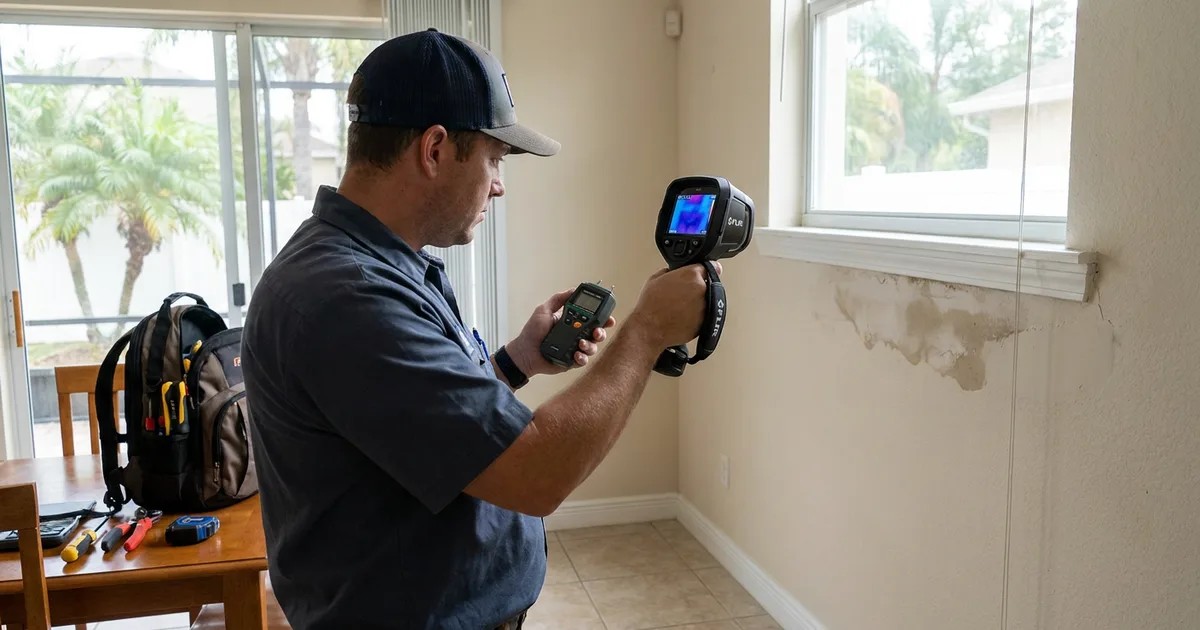
3. Moisture mapping. Moisture meters and thermal imaging cameras detect hidden dampness inside walls, under flooring, and behind ceilings. Readings above 16 to 20% in building materials are a red flag. This step is what separates a professional inspection from a homeowner eyeballing the walls, because a camera sees moisture that no visual check can.
4. Air and surface sampling. When the situation warrants it, the inspector takes air samples that measure spore concentrations in each room against an outdoor baseline, plus surface swab samples that identify the mold species on any visible growth. Samples are sealed and shipped to an accredited lab.
5. Lab analysis. Results return within 24 to 48 hours. The lab identifies spore types and counts and compares them against the outdoor control sample, which is how you tell active growth from normal background levels.
6. Written report. The deliverable covers photos of problem areas, moisture readings, lab results, the mold species identified, a hypothesis on the source, and a written remediation protocol. In Florida that protocol is not a suggestion. It is the document a licensed remediator must follow.
A little preparation protects the accuracy of the results. Keep windows closed for 12 to 24 hours before the visit, leave the suspect area undisturbed so you do not scatter spores, and have a rough timeline of any past leaks ready for the consultation. You can see how we run each of these stages on our mold inspection in Orlando page.
Knowing the process answers what you are paying for. Here is what it costs.
How Much Does a Mold Inspection Cost in Orlando?
Mold inspection cost in Florida varies more than most homeowners expect, and Orlando is one of the cheaper places in the state to get one. The national average is about $650 according to 2026 Angi data, and South Florida markets like Miami-Dade and Broward routinely run $600 to $1,000 or more for a standard residential inspection. Orlando comes in well below both: for a thorough inspection with sampling here, expect $300 to $600.
There are three service levels, and which one you need depends on whether you already have visible mold or are trying to confirm a suspicion.
| Service level | What it includes | Orlando cost |
|---|---|---|
| Visual only | Inspection and moisture mapping, no lab samples | $150 to $250 |
| Visual plus 2 to 3 air samples | The most common residential approach | $300 to $450 |
| Full inspection with lab analysis | Comprehensive sampling and species identification | $400 to $600 |
The mid tier is what most Orlando residential inspections involve. Visual only is fine for a quick check, but it cannot confirm spore levels, so it leaves the most important question unanswered.
If you need more than the standard bundle, the add-ons are straightforward. Extra air samples run $30 to $75 each, surface swab samples $20 to $60 each, and rush lab processing $25 to $75 per sample. Size also moves the number. Each additional 1,000 square feet typically adds $50 to $100 to cover the extra time and air samples a larger property needs. Commercial properties sit in their own bracket entirely, from $500 to $2,500 and up.
One cost most homeowners miss is post-remediation clearance testing. After any remediation is finished, a licensed assessor, which by Florida law must be a different company from the remediator, should run clearance testing to confirm the work succeeded before anyone moves back in. That runs $250 to $400 and is close to mandatory in Florida practice. Budget for it upfront so it does not surprise you at the end of a project.
Price matters, but who you hire matters more. Florida law is specific about this.
Florida's Mold Inspector Licensing Law: What to Ask Before You Book
Florida is one of the few states with a dedicated licensing regime for mold assessors and remediators, set out in Chapter 468, Part XVI of the Florida Statutes. The licensing authority is the Department of Business and Professional Regulation, the DBPR. Operating without a license is illegal, and that single fact gives you a fast way to screen any company.
Every licensed mold assessor holds a state license with a verifiable DBPR number. Ask for it before you book, then spend 30 seconds confirming it at myfloridalicense.com. Anyone who cannot produce a number should be crossed off your list immediately. This is not a nice-to-have check. It is the difference between a regulated professional and someone with no accountability.
The most important protection in the law is the conflict-of-interest rule. Florida explicitly prohibits the same individual or company from both assessing and remediating the same property. The reason is obvious once you see it. An inspector who also sells remediation has every incentive to find more problems than exist. The law removes that incentive by forcing the two roles apart.
It helps to be clear on the terms. A mold inspection, or assessment, is the diagnostic step that finds and measures the problem. Remediation, often called mold removal, is the separate hands-on job of cleaning it up and fixing the moisture source. They are two different services, and in Florida they must be performed by two different licensed companies.
So if a company offers to both inspect your home and clean it up, they are either ignorant of the law or counting on you being ignorant of it. Either way, decline. There are red flags worth rejecting on the spot:
- No DBPR license number, or refusal to provide one
- The same company offering to both assess and remediate
- “Free inspection” offers, which are usually a sales tactic that excludes sampling and lab costs
- Pressure to act before the lab results are back
- No written report or remediation protocol
None of this takes long to verify, and it filters out the operators you do not want anywhere near a five-figure remediation decision.
What Happens After the Inspection
The report you receive does more than confirm whether you have mold. It becomes a working document, not a summary to file away. In Florida the remediation protocol inside it is the legal instruction set a licensed remediator must follow to the letter, and it doubles as the paperwork your insurer will ask for.
Coverage depends on the cause. Sudden-onset water damage, like a burst pipe, typically triggers coverage, while gradual or neglect-related moisture is usually excluded. Many Florida policies now carry mold sub-limits of $10,000 to $25,000, so confirm yours before assuming a large job is fully covered. The 264,000 claims Floridians filed in 2022 are exactly why insurers have tightened these terms.
The final step closes the loop. When remediation is complete, book clearance testing with a different licensed assessor, and do not reoccupy the space until it passes. That test is your proof the work was done properly, and on a humid Florida property it is the only thing that tells you the problem is genuinely gone rather than hidden.
None of this is complicated once you know the sequence. A mold inspection in Orlando is a well-defined, predictable process, and a $300 to $450 inspection is cheap insurance against discovering remediation costs months later. If you have seen any of the warning signs above, the sensible move is to book rather than wait out another humid season.