01
Florida humidity
Indoor relative humidity rarely drops below 70% in Orlando summers. That level sustains active mold growth inside walls, attics, and HVAC systems — often invisible until it has spread.
Free inspection, same-day written quote — no inspection fee, no guessing, no national-franchise wait list. Orlando Mold Works handles mold removal and remediation end-to-end under one Florida DBPR license.
Indoor relative humidity rarely drops below 70% in Orlando summers. That level sustains active mold growth inside walls, attics, and HVAC systems — often invisible until it has spread.
Post-storm moisture from Irma (2017), Ian (2022), and seasonal flooding routinely reaches concealed cavities. Even a sealed-looking ceiling can harbour a colony behind the drywall.
High AC usage creates sharp temperature differentials. Condensation forms inside ductwork, air handlers, and insulated walls — the three most-missed locations in a DIY inspection.
Remediation isn’t cleaning. It’s a structured, regulated process with six distinct stages — and skipping any one of them is why mold comes back.
Visual survey, moisture mapping (meters plus IR camera), and a borescope for concealed cavities. We identify every affected zone, not just the visible patch. Start with a free mold inspection.
A written document: affected areas, root cause, sampling results where taken, and the full proposed scope. This is the report your insurance adjuster needs.
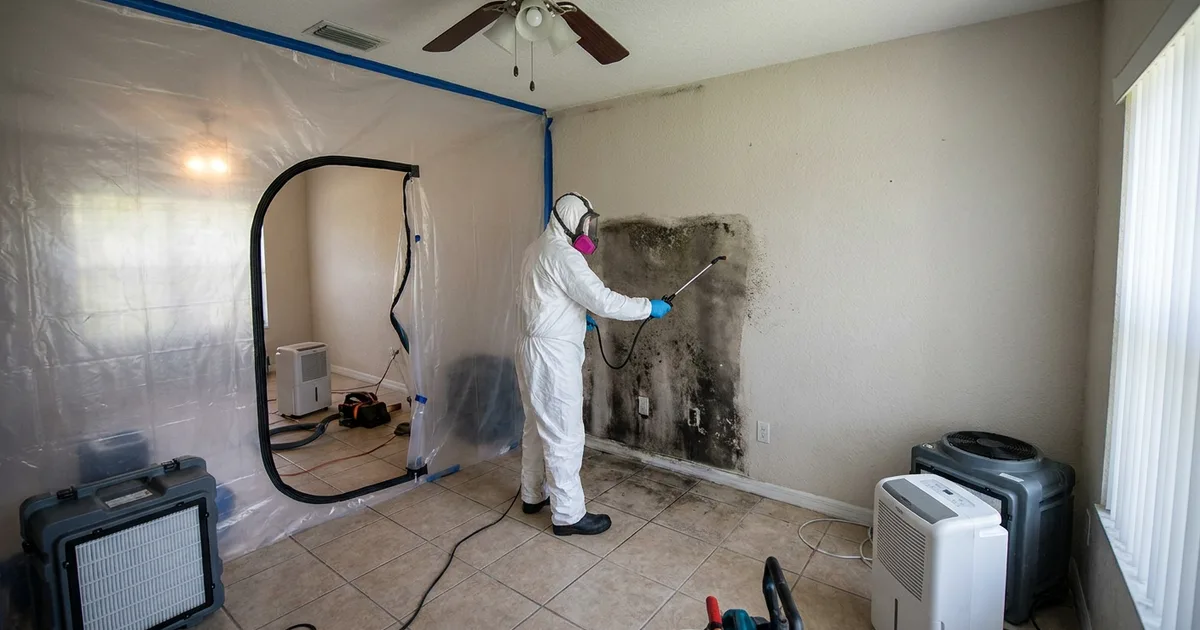
Plastic sheeting, negative air pressure, and HEPA filtration. Spores are contained to the work zone so the rest of your home stays clean.
Compromised materials (drywall, insulation, framing) are removed and bagged. Remaining surfaces are treated with DBPR-approved antimicrobial agents.
Industrial dehumidifiers and air movers eliminate the moisture source that caused the growth. No drying means guaranteed recurrence.
Third-party air sampling by a separate licensed assessor confirms remediation success. You receive a written clearance certificate.
Choosing an unlicensed contractor in Florida can void your insurance claim and leave you personally liable. Here is exactly what the law requires.
The Florida DBPR publishes every licensed mold remediator at myfloridalicense.com. Ask for the license number before you sign anything. Orlando Mold Works’ DBPR license number is displayed on every written quote.
Verify a Florida Mold Contractor →Verify the Mold Remediator license number at myfloridalicense.com before any work begins. This is the non-negotiable first step.
IICRC-certified technicians are trained to the S520 standard — the industry benchmark for containment, removal, and post-remediation verification.
Protects you if a worker is injured on site or accidental damage occurs. Ask for certificates, not just a verbal yes.
No verbal quotes. A legitimate company lists every affected area, the proposed methods, and what clearance testing will confirm — in writing.
The job is only complete when an independent assessor’s air sample says it is. Companies that self-certify their own clearance have a conflict of interest.
Price-cutters and unlicensed operators rely on homeowners not knowing the rules. Here is how to spot them before they cost you.
Impossible. Mold spores exist in all outdoor and indoor air — the goal is returning levels to the ambient baseline. Any company making this claim is misrepresenting the science or the scope.
A headline number with no written scope signals scope creep later, unlicensed work, or materials that won’t be replaced properly. Always compare written scopes, not verbal numbers.
A company confident in its work welcomes independent verification. Pressure to skip clearance protects only the contractor — not you.
typical residential project in Florida
Most common range for a standard single-room job: $3,000 – $4,500
Affected square footage, material type (drywall vs. framing vs. HVAC ductwork), accessibility (crawl space vs. finished room), and hidden mold discovered during removal.
Mold from a sudden event (burst pipe, storm intrusion) is more likely to be covered than gradual accumulation. Our written assessment report gives the adjuster what they need.
Most homeowners call without knowing how bad the problem is. A free same-day inspection removes the cost-guessing barrier — you see the scope before you commit to anything.
Mold accounts for more than 20% of all Florida homeowner insurance claims. A professional written assessment is often the document that unlocks coverage.
We’ll be in touch the same day to confirm a time. No fee. No commitment. We tell you exactly what you’re dealing with before you decide anything.
A professional mold remediation company returns mold levels inside your home to the naturally occurring baseline found in outdoor air — not eliminating every spore (impossible), but removing active colonies, treating contaminated surfaces, drying the moisture source, and verifying success with post-remediation air sampling. The process involves inspection, containment, physical removal, drying, and a final clearance test by an independent assessor.
Yes. Under Chapter 468, Part XVI of the Florida Statutes, any mold-related services performed on areas greater than 10 square feet require an active Mold Remediator license from the Florida Department of Business & Professional Regulation (DBPR). You can verify any contractor’s license at myfloridalicense.com. Hiring an unlicensed company voids most insurance claims and creates personal liability for the homeowner.
Most residential mold remediation projects in Florida fall between $1,500 and $6,000, with the most common single-room or small-area jobs running $3,000–$4,500. Cost is driven by the size of the affected area, the materials involved (drywall vs. framing vs. HVAC ductwork), and accessibility. Orlando Mold Works provides a written same-day quote after a free inspection — you see the full scope before committing.
No — Florida law requires a clear separation between the Mold Assessor (who inspects, samples, and writes the scope) and the Mold Remediator (who does the physical removal). The same company cannot legally perform both roles on the same project. Any company that offers to assess and remediate under one contract is either operating illegally or structuring the engagement in a way that conflicts with your interests.
A standard single-room job typically takes one to three days — one day for removal and treatment, one or two days of structural drying, and a final clearance test once the area is dry. Larger or multi-room jobs with significant moisture damage can take five to seven days. Your written scope will include a time estimate before any work begins.
It depends on the cause. Mold from a sudden, covered event (burst pipe, storm water intrusion) is more often covered than mold from long-term moisture accumulation or deferred maintenance. A professional written assessment from a DBPR-licensed company is typically the document your insurance adjuster needs to evaluate the claim. Mold claims make up more than 20% of all Florida homeowner insurance claims — getting the documentation right matters.
Free inspection, same-day quote — call or submit the form and we’ll confirm a time today.