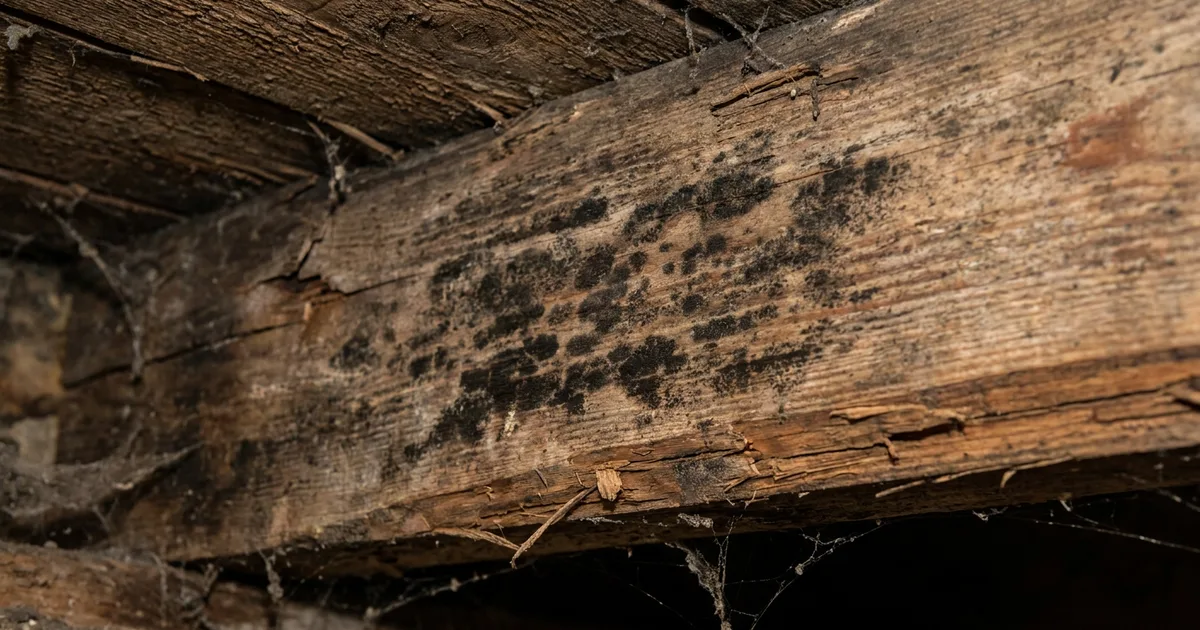
Florida scores 38.76 out of 40 on the national Mold Index, the highest score in America. If you have found black mold on wood somewhere in your home, you are not dealing with a bad-luck incident. You are dealing with a climate that runs mold-optimal conditions almost every day of the year.
That matters because most of the advice you will find online was written for a generic US audience, where humidity drops back to safe levels after a leak dries out. In Central Florida the air itself is often the moisture source, so the standard thresholds and cleanup routines do not transfer cleanly. This guide is written for the Florida situation specifically. By the end you will know what you are actually looking at, why our climate makes wood mold worse, what genuinely kills it, and where the line sits between a job you can handle with a scrub brush and a job that needs a professional. No vague “consider calling an expert” hedging.
What You’re Actually Looking At (Not All Black Mold Is the Same)
“Black mold” is a visual description, not a species. The dark growth on your wood could be several different fungi, and they do not all behave the same way.
Cladosporium is olive-green to black with a suede-like texture, and it is extremely common on painted wood and window sills. Aspergillus niger is black with a powdery, granular texture. Stachybotrys chartarum, the species with the fearsome “toxic black mold” reputation, is greenish-black and slimy or gelatinous when wet. Texture is the rough field guide here: slimy points toward Stachybotrys, while powdery or suede-like points toward a more common species. Visual identification alone is never definitive, though. Confirming the species takes lab testing.
Here is the part that cuts through the panic. The species does not change your first move. Stachybotrys needs sustained moisture, typically a week or more of wet material, before it establishes, so if you found mold shortly after a single leak it is more likely a faster-growing species. But there is no version of this that you get to ignore. The Florida Department of Health recommends removing all indoor mold growth regardless of species. There is no “harmless black mold on wood” that earns a pass. Worrying about whether yours is the dangerous kind is a distraction from acting on it.
Whatever the species, the real question in Florida is not “which mold is this?” It is “why is my wood wet enough to grow it?” The answer almost always comes back to the same thing: climate.
Why Black Mold on Wood Is a Bigger Problem in Florida
That Mold Index score is not trivia. It means the conditions that accelerate mold growth are present nearly every day of the year, with no winter to shut them down.
Mold colonises a wet wood surface in 24 to 48 hours once indoor relative humidity passes 60%, and Florida’s morning humidity routinely sits at 85 to 96%. Most of the country gets a recovery window after a leak dries. Here, the air stays loaded, so a wet board often never gets one. The state averages 72.7°F, the highest annual temperature in the US, and roughly 56 inches of rain a year, the second-highest. Warmth plus water plus cellulose is exactly the recipe mold wants, and Central Florida serves it year-round.
The scale of the problem shows up in the insurance data. Florida homeowners filed over 264,000 mold-related insurance claims in 2022, more than 20% of all home insurance claims in the state that year. This is not a rare event. It is one of the most common ways a Florida home goes wrong.
Certain wood structures fail far more often than others here. Watch these in particular:
- Crawl space floor joists and subfloor sheathing, where below-grade humidity and poor airflow combine
- Roof sheathing and rafters, where hurricane and storm penetrations expose raw wood to sustained wet
- Wood window and door frames, where AC-cooled interiors meet hot exteriors and condensation forms
- Bathroom and laundry room joists, fed by slow plumbing leaks and steam
- Wood decks, pergolas, and fences, exposed to the full June to September rainy season
- Attic sheathing, where poor ventilation meets Florida summer heat
How to Identify Black Mold on Wood (and Test How Deep It’s Gone)
What does mold look like on wood? Colour runs from black to dark greenish-black to olive-brown. Texture ranges from slimy to powdery to suede-like depending on the species. (Flat, grey-white powder on the surface may just be mildew — our guide to the difference between mold and mildew has a quick 3-question test.) The earliest cue is often not visual at all. A musty, earthy odour usually arrives before you can see anything, especially in low-light, low-ventilation spaces. Location is a strong tell too: any wood near plumbing, below a roof penetration, or that sat wet for more than 48 hours is a prime suspect.
The single most useful test costs nothing. Wipe a small area with a damp cloth. If the discolouration clears, the mold is sitting on the surface finish. If the discolouration stays, the mold has likely penetrated the grain below the surface.
This is the test that decides whether DIY is even on the table. Surface mold on sealed or painted wood is a candidate for cleaning. Black mold in wood that has reached raw, porous, or structural timber is a different problem, because mold penetrates roughly an eighth to a quarter inch into raw lumber. That is deep enough to reach the structural fibres, and deeper than vinegar or hydrogen peroxide can reliably follow.
Once you know what you are dealing with, the next question is how to treat it. This is where most guides send Florida homeowners straight toward the worst possible solution.
Stop: Bleach Does Not Kill Black Mold on Wood
So, what kills black mold on wood? Not bleach. Reach for the bleach bottle and you will make the problem worse, not better. This is not a fringe opinion. It is the consensus among remediation professionals, and the reason they warn against bleach on porous surfaces like wood.
The mechanism is simple once you see it. Bleach is water-based. On porous wood, the water carrier soaks into the grain and drives the mold deeper while handing it the one thing it needs to survive, more moisture. The sodium hypochlorite that does the actual killing cannot follow. It stays on the surface. So the staining vanishes and the wood looks clean, while the colony lives on below the finish. Within a few weeks, it comes back.
Use these instead:
- White distilled vinegar, undiluted. The best DIY option. Its acidity lets it seep into the wood pores where the mold lives. Apply it, leave it for an hour, then scrub with a soft brush. It is commonly reported to kill around 80% of mold species. Do not dilute it.
- Hydrogen peroxide, 3%. Apply, leave for 10 minutes, then scrub and rinse. Effective on surface mold and well suited to finished or painted wood.
- Dish soap and warm water. For surface mold on sealed or painted wood only. Gentle enough that it will not raise the grain.
The drying step matters as much as the treatment. Mold cannot survive without moisture, so after cleaning, use fans, a dehumidifier, or low-heat drying until the wood is completely dry. In Florida, rushing this step hands the colony a fresh start before the day is out.
DIY or Call a Professional? The Decision Framework for Florida Homes
The EPA sets the DIY threshold at 10 square feet, roughly a three-foot by three-foot patch. For most of the US that is a reasonable cutoff. In Florida, treat it as a hard maximum rather than a comfortable target, because persistent humidity makes a return far more likely unless the moisture source is fully fixed.
Handle it yourself only when all of these are true:
- The affected area is under 10 square feet
- The wood is painted, sealed, or finished, so the mold is on the surface
- The wood is non-structural, such as trim, furniture, or a cabinet door, not a joist, subfloor, or rafter
- It has not come back after cleaning, since a return signals an ongoing moisture source DIY cannot fix
Call a professional when any of these are true:
- The area is larger than 10 square feet
- The mold is on raw, unfinished, or structural wood: floor joists, subfloor boards, roof rafters, or wall framing
- The wood feels soft, spongy, or crumbles, which means the structure is already compromised
- It returns within weeks of cleaning, which means the moisture source must be found and sealed
- A musty odour lingers after surface cleaning, a sign the mold has gone deeper than the finish
- The growth is in a crawl space or attic, where confined work demands containment equipment and protective gear
- Anyone in the home is an infant, elderly, asthmatic, or immunocompromised, because their risk threshold is lower
On cost, professional mold remediation runs roughly $8 to $15 per square foot nationally. Before you rule a professional out on price alone, check your policy: water-damage-related mold is sometimes covered by homeowners insurance, which can change the math entirely. A professional mold inspection in Orlando tells you which scope you are actually facing before you spend a dollar on the fix.
A proper job involves more than spraying something on. It means containment under negative pressure to stop spores spreading, protective equipment, removal of contaminated wood where the growth has reached the structure, an EPA-registered biocide, and clearance air testing afterward to confirm spore levels are back to normal. If you decide to bring someone in, our guide on how to choose a mold remediation company covers what separates a good contractor from a bad one.
If professional remediation is not needed today, prevention is what keeps it that way. In Florida, that takes more active management than in most of the country.
Preventing Black Mold on Wood in Florida: What Actually Works
Keep indoor relative humidity below 60%, and aim under 50% through the June to September rainy season. Air conditioning and dehumidifiers are both tools, and AC alone is often not enough during the rainiest months, when the outdoor air is at its most saturated. Use an inexpensive hygrometer so you are measuring rather than guessing.
Respect the 24 to 48 hour rule. Any water damage, whether a burst pipe, a roof leak, flooding, or a long-running condensation drip, has to be dried within 48 hours. That is the colonisation window. Once it closes, the clock has already started.
If your home has a crawl space, encapsulation is the highest-value prevention step you can take. An unencapsulated Florida crawl space can hold relative humidity well above the 60% mold threshold all year round, condensing moisture straight onto the floor joists above it. Joist mold is one of the most common and most expensive problems in Central Florida homes, and the crawl space is where it almost always starts.
After any tropical storm or heavy rain, inspect your roof sheathing and attic for penetrations. Because the colonisation window is so short, a next-day check can catch moisture before a colony forms. While you are up there, confirm that bathroom exhaust fans vent to the outside and not into the attic. Venting into the attic is a common Florida installation error that pumps moist air straight onto roof sheathing, a prime mold location. Finally, treat exterior wood, your deck, pergola, and fences, with a mold-resistant sealant once a year, because outdoor wood here takes far more punishment from the rainy season than in any other US climate.
If you are not certain the mold you found is surface-only, the cost of being wrong is higher than the cost of an inspection. The trickiest cases, structural wood, crawl spaces, post-storm damage, and growth that keeps coming back, are also the most common ones in Central Florida homes, and they are the ones where a wrong guess gets expensive. Orlando Mold Works offers a free inspection so you can find out exactly where you stand before you spend a dollar on the fix. Call (321) 257-9332 and get a straight answer while the choice is still yours.