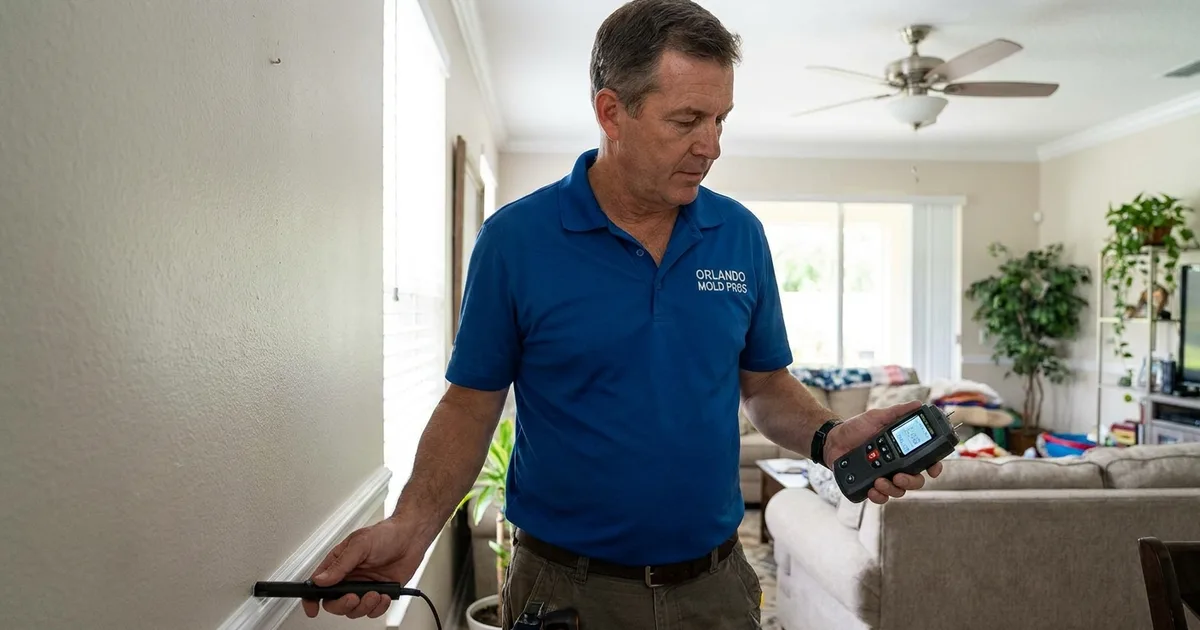
Florida homeowners filed roughly 264,000 mold-related insurance claims in 2022 alone, more than 20% of all home insurance claims in the state. If you live in Orlando and you are wondering whether that musty smell is worth investigating, you are asking the right question.
Florida is the second most mold-prone state in the country, behind only Louisiana. Orlando’s humidity swings from around 55% in the early afternoon to nearly 89% before dawn, and once indoor humidity passes 60%, mold can start colonizing surfaces within 24 to 48 hours. This is not Iowa. The numbers here are different, and so is the right answer to how much you should expect to pay.
This guide gives you the real Orlando mold inspection cost ranges, what pushes a quote up or down, and a few Florida-specific rules that most national cost guides leave out. By the end you will know what a fair number looks like before you call anyone.
What Does a Mold Inspection Cost in Orlando?
Most residential mold inspections in Florida run $300 to $600. Orlando specifically trends toward the upper half of that band, with aggregator quotes for the metro landing anywhere from $350 to $900 or more depending on the property and the scope of work.
For context, the national average mold inspection cost sits at around $670 according to Angi’s 2026 data, and HomeAdvisor’s analysis of 343,231 real quotes puts the average at $687. Orlando sits broadly in line with the rest of the country, which means a quote far above that band for a standard residential inspection is one you should make them justify.
The reason the range is so wide is that “mold inspection” covers three genuinely different services. Knowing which one you need is the difference between a $200 visit and a $600 one.
| Service type | What’s included | Typical Orlando price |
|---|---|---|
| Visual inspection only | Expert walkthrough with moisture meters, no lab samples taken | $150 to $250 |
| Visual inspection + sampling | Walkthrough plus 2 to 3 air or surface samples sent to a lab | $300 to $450 |
| Full inspection + lab analysis | Full moisture map, thermal imaging, 4 to 6 samples, written report with lab data | $400 to $600 |
A visual inspection makes sense when you already have visible mold or a clear moisture source and just need a professional to confirm presence and scope. It will not identify the species and will not catch mold hidden inside a wall, but for an obvious problem it is often all you need.
Adding air or surface sampling makes sense when mold is suspected but not visible, for example a musty smell with no obvious growth. Each additional sample beyond the base package adds $75 to $150 in lab fees, and results typically take three to five business days to come back. The full lab package, at $400 to $600 for most Orlando homes, is the right call for a home purchase, an insurance claim, or post-remediation clearance testing.
The roughly $300 gap between a basic visual check and a full lab analysis does not happen at random. These six factors drive your quote up or down.
What Drives the Price Up in Orlando
Property size is the base rate driver. Most pricing tracks square footage, at roughly $0.10 to $0.15 per square foot for a full inspection, so a 1,200 square foot condo and a 3,500 square foot house are never going to cost the same.
Hidden and inaccessible areas add the next layer. Crawl spaces, attics with poor access, and mold suspected inside HVAC ducts all take more time and equipment, and central AC is universal in Orlando, so duct inspection comes up constantly here. Each additional air or surface sample tacks on another $75 to $150 in lab fees, which is how a quote climbs when an inspector needs to test several rooms.
Then there are the Florida-specific pressures. After a hurricane or a flooding event, demand spikes across the metro and some inspectors charge urgency premiums for emergency scheduling. Older construction matters too, since roughly half of Florida homes were built before the mid-1980s, and pre-1985 building materials can complicate access to suspect areas.
The takeaway is simple. If you have a 3,000 square foot home with a crawl space and a leak after a storm, you are looking at the top of the range, and you should not be surprised when the quote reflects it. A small condo with one visibly damp bathroom and an obvious source sits at the bottom.
Before you schedule anything, it helps to know the difference between an inspection and testing, because Florida’s own health department has a specific view on which one you actually need.
Mold Inspection vs. Mold Testing: Which One Do You Actually Need?
An inspection is an expert visual and instrumental assessment. The inspector uses moisture meters, sometimes thermal imaging, and humidity readings to find where the problem is and what is causing it. Testing is different. Testing means sending physical samples (air, swab, or surface) to an accredited lab to identify what species you have and at what concentration. Mold testing on its own, without a full walkthrough, runs $250 to $500 according to Angi’s 2026 figures.
Here is the part most cost guides skip. The Florida Department of Health does not routinely recommend mold testing for homeowners. Its position is that a visual inspection by a qualified professional is more actionable, because finding the moisture source and the extent of the growth matters more than a lab confirming that mold is, in fact, mold.
Testing earns its cost in specific situations: when mold is suspected but not visible, when a health investigation needs species identification, for legal or insurance claims, and for post-remediation clearance. Air sampling can detect elevated spore counts even before visible growth appears, which is exactly when it is worth paying for.
Keep that in mind when a salesperson pushes a comprehensive lab package. Testing costs more, takes three to five business days, and often tells you less than a skilled inspector can determine on site. If you have visible mold or an obvious moisture source, what you need is someone who can find the cause and tell you how bad it is, not a lab report confirming what you already know.
5 Situations Where an Orlando Homeowner Should Book an Inspection
Knowing the difference between inspection and testing tells you what to buy. Knowing when to buy it is a different question, and in Orlando there are five situations where you should book one without overthinking it.
1. You are buying a home. Treat a mold inspection as a standard part of due diligence, not an optional extra. In Florida’s climate it should be routine, and if mold is found during the inspection period, it becomes a negotiating lever or a walkaway condition. A professional mold inspection in Orlando during due diligence is cheap insurance against a five-figure surprise.
2. You can see mold or smell a persistent musty odor. Even a small visible patch can signal a larger colony behind the surface. A musty smell with no visible growth is the harder case, and it is the one where air sampling genuinely helps locate a hidden problem.
3. You have had a storm, hurricane, or flooding. Orlando sits in a hurricane-prone corridor, and the 24 to 48 hour window is what matters. Once indoor humidity passes 60%, mold can colonize within that window, so if water got in and was not fully dried in time, an inspection is warranted.
4. You have repaired an HVAC or plumbing leak. Slow AC condensate leaks and hidden pipe drips are the number one source of hidden mold in Orlando homes, and central AC is in nearly every property here. A repair that does not confirm the area is clear can leave mold growing behind the fix.
5. Someone in the home has unexplained health symptoms. Persistent respiratory irritation, worsening asthma, or unexplained allergies with no other clear cause are worth investigating. The Florida Department of Health notes that mold exposure can trigger allergic illness, respiratory irritation, and, in immunocompromised people, infection. With Orlando’s daily humidity running as high as 89% before dawn, the conditions for a problem are present year round.
The Florida Law That Protects You From Being Oversold
Once you have decided to book an inspection, there is a Florida-specific rule worth understanding before you pick up the phone. It is the one thing that separates a legitimate inspection from a sales pitch.
Florida Statutes §468.84 through §468.8424 prohibit a single licensed company from both assessing mold and performing the remediation on the same property. The law exists specifically to remove a conflict of interest. An inspector who also sells remediation has a direct financial incentive to find, or exaggerate, mold.
In practice it works like this. The company that inspects your home cannot also clean it up. You receive an unbiased assessment report, and then you hire a separate licensed mold remediation company to carry out any actual work. Both mold assessors and remediators are licensed through Florida’s Department of Business and Professional Regulation, the DBPR.
This matters because in states without this rule, the company doing your inspection is often the same one that then hands you a five-figure remediation bill. Florida removed that conflict of interest. A mold assessor here has nothing to sell you except an accurate report, and most national cost guides never mention that this protection exists.
DIY Mold Test Kits: What They Can (and Can’t) Tell You
Before calling a professional, you will probably Google “mold test kit” and find $10 to $50 boxes at the hardware store. The honest assessment is short.
DIY kits detect mold presence, but not quantity or concentration. In Orlando’s humidity a home test kit will almost always come back positive for something, because mold spores are everywhere in Central Florida’s air. That result tells you nothing about whether you have a problem inside your walls or under your floors. The kits cannot identify hidden mold or locate the moisture source, which is the genuinely useful thing to know, and their results are not accepted by insurance companies or courts. The Florida Department of Health does not recommend routine testing for homeowners in the first place.
The verdict: save the $30. A DIY kit is fine for satisfying curiosity and useless for anything practical in Florida. If you do hire a professional, here is what should be in the report you receive, and two things that should make you walk away.
What a Professional Mold Inspection Report Should Include
A complete inspection report should include the property address, the inspection date, and the inspector’s name and license number, which is required under Florida DBPR rules. It should list every area inspected, record moisture and humidity readings throughout, and include photographs of suspect areas and the moisture sources behind them.
If samples were taken, the report should include the lab results with mold species and spore counts, alongside an outdoor baseline sample. The baseline is standard practice, because you cannot judge whether your indoor spore count is abnormal without knowing the ambient outdoor level in Central Florida. Finally, it should recommend both remediation and moisture source correction. If it only tells you to remove the mold without fixing the cause, the mold will come back.
Two red flags should make you walk away. The first is a missing DBPR license number, which suggests the inspector may not be licensed. The second is lab results presented without an outdoor baseline, because without it the numbers are meaningless.
Armed with what to expect on pricing, what type of inspection fits your situation, and what a proper report looks like, you are ready to make a decision.
If you are in Orlando and want a straightforward quote, with no upsells and no lab packages you do not need, Orlando Mold Works inspects residential properties across the metro. Call (321) 257-9332 or use the form below and we will get back to you the same day.